
The Creature at the Window
What the Cameras Cannot See

Nobody is hiding this. The Census Bureau publishes it. The Federal Register describes it. The mechanism is statutory, transparent, and operating exactly as its architects intended: a person detained in a rural immigration facility is counted, for purposes of congressional apportionment, as a resident of that facility’s county — not of the city they were taken from. The facility is in a conservative rural district. The city is not. The detained person cannot vote. Their body, present in the record, inflates the representation of the coalition that detained them, while simultaneously deflating the representation of the community that lost them.
This is not a side effect. It is the point.
And it has been made invisible not through secrecy but through complexity, through the gap between the cruelty the cameras can see and the arithmetic the cameras cannot. The outrage is real and should not be quieted. But outrage directed only at the cruelty leaves the arithmetic untouched, and the arithmetic is what compounds. We have been in this position before. We know what happens when we fight the visible form of the harm while the institutional form completes itself unobserved. This essay is about that mechanism, where it comes from, how it works at every scale simultaneously, and where, if we are serious about interrupting it, we must go.
Follow the children. They will show us the way in, and the way out.
1. The Pipeline
My daughter came home and told me she had been hacked. She didn’t know yet that her friends had done it.
While she was out sick, three of them logged into her school account, changed her settings, then changed their own so they could claim they’d been hacked too. They broke her crayons. They covered their tracks. They waited. When the school asked them to write apology letters, each one wrote that she needed space from my daughter, the language my daughter had used days earlier when they engaged in gossip about others. They took the words of the person they had targeted and redirected them back at her as a grievance. The institution, lacking the instrument to distinguish between the two, accepted both as equivalent expressions of hurt feelings, issued the letters, and closed the file.
They are in fourth grade.
What they did required no physical contact, no raised voice, no evidence of intent. It required digital access, coordinated deception, institutional fluency, and the sophisticated use of the school’s own conflict resolution vocabulary against the person that vocabulary was designed to protect. The school had a cybersecurity policy and an anti-bullying policy. None of them reached what happened. They were calibrated for an earlier form of the harm.
I did not write this essay because my daughter was hurt. I wrote it because of what her school could not see, and why.
The inability to read that violation was not a failure of individual teachers or administrators. It was the predictable output of two decades of policy that has systematically stripped American public schools of the instruments required to recognize coordinated institutional harm. School counselor ratios have collapsed. Civics instruction has been replaced by standardized testing. Social-emotional learning programs, where they existed at all, have been defunded or legislated against in the same political cycle that produced the Callais ruling. What remains is a procedural skeleton: report the incident, collect the letters, close the file. The framework was designed to document harm already done. It has no mechanism for naming coalition behavior, no instrument for coordinated performance, no framework for collective harm that leaves no individual fingerprint.
This is not an accident of underfunding. It is the predictable consequence of a sustained political project that has a direct interest in producing institutions that cannot read the mechanism, because the mechanism operates at every scale simultaneously, from the fourth-grade classroom to the Supreme Court, and an institution that could name it in one place could name it in all of them.
Here is what the defunding produces: a generation of children sorted, before they are ten years old, into those who have learned to operate the mechanism and those who will be processed by it, with no adult in the building trained to see the difference, no policy with the vocabulary to name it, and no record that captures anything other than that two parties each expressed a need for space. The violation and its performance appear in the institutional file as equivalent. The coalition closes. The letters arrive. The institution nods.
My daughter survived it because I gave her a counter-curriculum the school could not. Each afternoon I ask her one question: did you help anyone today? Not as politeness. Not as a lesson in kindness. As a daily demand that the force in her, the same force her friends deployed against her, the same force the school tried to prohibit and produced instead in its most precocious and coordinated form, was spent in a direction the coalition cannot weaponize. It redirects the nervous system from audit to attention: from how am I doing to what does the room need.
That question is political. It is also, for most children in American public schools right now, being asked by no one.
The parents who understand this most viscerally are not the ones reading legal analysis of Callais. They are the ones watching their children come home from institutions that have been methodically stripped of the capacity to protect them: not from fistfights, which the institution can still see, but from the sublimated form of the harm, the coordinated invisible form, the form that learned to use the institution’s own vocabulary as its instrument. Those parents are the most prepared audience for the structural argument this essay makes. They are watching it in miniature, in real time, every afternoon. And no one has yet connected the two registers for them.
The mechanism does not change when it moves between scales. The fourth-grade coalition operating through apology letters and the Supreme Court majority operating through constitutional interpretation are running the same process. The difference is not kind. It is consequence. And the chain connecting them runs directly through the institutions we have spent twenty years teaching not to see.
2. The Dictionary
In 1911, Congress published the Dillingham Commission Report — forty-one volumes, three years, three hundred staff. Tucked inside Volume Five was the Dictionary of Races and Peoples.
Italians were not one race but two. Northern Italians: broad-headed, acceptable. Southern Italians — from Calabria, from Basilicata, from the mezzogiorno — were long-headed, dark, Mediterranean, culturally incompatible with American civilization. Poles, Czechs, Hungarians, Greeks: each wave cataloged and ranked.
The findings became law. The Immigration Act of 1924 encoded the hierarchy into quota policy. Italian immigration dropped ninety percent. The immigrants already here were offered assimilation.
Assimilation has always required a price. The price has always been the same.
The Irish paid it first, a million and a half in a decade, into a country that did not consider them white. The Democratic machine offered the terms: align with us, staff the institutions, maintain the fence. The fence was the political and economic commons: unions, police forces, civil service, that explicitly excluded Black workers. The Irish took the offer. Within two generations, they were white.
The Italians took longer. Eleven were lynched in New Orleans in 1891, the largest mass lynching in American history. The answer came contingent on World War II service, the GI Bill, mortgages from which Black veterans were systematically excluded. The Southern Italians moved to the suburbs. They forgot New Orleans. They forgot the dictionary.
The Jewish trade ran through anticommunism and professional class integration. The Holocaust made antisemitism toxic. The suburbs absorbed them too.
In 2024, the fence moved again. Trump received fifteen percent of the Black vote and came within three points of Harris among Hispanic voters — a collapse from Biden’s twenty-five point advantage in 2020. The Dillingham Commission is being updated in real time, without a dictionary.
It is not only white versus Black. It is assimilate or be damned: accept the framework of the system that enclosed you, adopt its vocabulary, help maintain the fence against those who share your heritage but have not yet been admitted, and receive in exchange the wages of belonging. The fence is not a color. It is a posture. A performed forgetting, required of everyone who wants to be inside, regardless of what the dictionary once said about their people.
The forgetting is not incidental to the trade. The forgetting is the trade.
3. The Arithmetic
The term “penal colonies” is not an official designation used by the U.S. government. It is the term human rights advocates and legal critics increasingly use to describe what the administration has built — and what those facilities are doing to the map.
By mid-2026, the administration has rapidly expanded active immigration detention centers, routing migrants to massive holding facilities in remote rural counties. Critics note that these are not merely punitive. They are geographic. And the geography is the mechanism.
Under current census rules, incarcerated individuals and immigrant detainees are counted as residents of the facility’s location — not their home communities. Major detention centers are overwhelmingly built in rural, predominantly white, politically conservative districts. The detained person cannot vote. But their presence in the census record inflates the population of that county, which inflates its congressional representation, which inflates the power of the coalition that built or leases the facility, which funds more facilities. This practice — known as prison gerrymandering — means the person expelled from their community becomes, through the arithmetic of apportionment, a unit of representation for the people who expelled them.
The loop closes at the census. A city loses population in the count when its residents are detained elsewhere. It loses congressional seats. It loses federal funding tied to population. The rural county gains all of it. The rural county’s legislature uses the inflated seat count to gerrymander district lines — packing immigrant and minority communities into as few districts as possible, or drawing lines around detention facilities where no one inside can vote. The legislature that results elects members who fund more detention. More detention moves more bodies to more rural counties. The count shifts further.
This is not speculation. It is the census statute operating as written, in a context it was not designed for — the structure of every iteration of this harm across American history. The instrument calibrated for an earlier moment, now wielded through the gap between its stated purpose and its operational effect.
What the news covers is the cruelty: the conditions in facilities, the separation of families, the deaths in detention. The cruelty is real and must be documented. But the cruelty is also the surface. The infrastructure beneath it is not failing. It is optimizing1. The administrative machinery beneath it — the census strategy, the geographic placement of facilities, the circuit court routing of legal challenges to conservative jurisdictions where civil rights claims are least likely to succeed, the financial pipeline to private prison corporations that then fund the legislators who expand the system — none of that generates the traffic that border footage generates. None of it can be captured in a photograph.
Semantic sanitization does the rest. Media outlets report on “Migrant Operations Centers,” “expanded bed space,” and “expedited removal frameworks.” By adopting administrative euphemisms, reporting inherently sounds like routine legal logistics rather than a coordinated effort to alter democratic representation. The outrage stays focused on what can be seen. The map keeps changing.
Conservative lawmakers understand the contradiction precisely, which is why they are simultaneously pushing to alter the substrate rules entirely. Measures like the Equal Representation Act seek to mandate that the Census Bureau exclude non-citizens from congressional apportionment altogether. If successful, this would shift the calculus permanently — but even without it, the current system is already performing the conversion. Bodies moved. Counts shifted. Maps redrawn. Seats reallocated. And the people inside the facilities, generating this representation, unable to vote against a single person who benefits from their presence.
The Dillingham Commission classified people. The current system moves them. The outcome is structurally identical: the political power of diverse urban communities compressed, the representation of the enclosing coalition expanded, and the instrument doing the work dressed in the neutral language of administration.
4. The Inversion
The Republican Party was founded in 1854 to oppose the expansion of slavery. Lincoln was its first president. Douglass was one of its champions. In 1956, Eisenhower received nearly forty percent of the Black vote.
The party that freed the enslaved is now the party that dismantled the VRA. That inversion did not happen by accident. It happened by trade.
FDR’s New Deal pulling Black voters toward Democrats. Truman desegregating the military, Thurmond walking out. Johnson signing the Civil Rights Act and reportedly telling an aide, we have lost the South for a generation — an underestimate. Goldwater sweeping the Deep South after voting against the Act. Nixon’s Southern Strategy. The long migration of racial resentment from explicit language to coded language to economic abstraction, until the resentment was legible only in its effects.
Lee Atwater described the mechanism in 1981, believing he was speaking privately. You start with the slur. Then, as that becomes toxic, you abstract: states’ rights, busing, welfare. Then further — tax cuts, spending reduction — until the racial content is gone from the surface and present only in who gets hurt. “A byproduct of them,” Atwater said, “is that Blacks get hurt worse than whites.”
This is the spiral Norbert Elias spent his career mapping — aggression sublimated from the body into institutions, each iteration more laundered than the last — applied now to electoral politics. The explicit violence of Reconstruction-era suppression: the Klan, the lynchings, the paramilitary enclosure of the political commons, was at least legible as violence. It could be named, documented, legislated against. The Southern Strategy achieved the same outcome through economic abstraction. The census strategy achieves it through population arithmetic. Callais achieves it through constitutional interpretation. Each iteration is less visible, more durable, and more completely insulated from the remedies designed for its predecessor.
The Republican Party did between 1964 and now what the Irish did between 1845 and 1900. It assimilated. It accepted the Southern white coalition’s framework, adopted its vocabulary, helped maintain its fence. The party forgot what it was. It was elevated. And then, from the bench, it drew the fence where the coalition needed it drawn.
This is why the fence is moving again in 2026 — absorbing Hispanic, Black, and Asian voters into the coalition’s outer ring while tightening the definition of who remains permanently outside. What looks like realignment is coalition maintenance. What looks like demographic surprise is the fence doing what fences do: moving to wherever the arithmetic requires it, with the people inside performing the solidarity that proves they belong.
The court that produced Callais is not an aberration. It is the institutional endpoint of a sixty-year assimilation event — the Republican Party having completed, through judicial appointments and Federalist Society pipelines, the same trade Southern Italian immigrants completed through the GI Bill and the suburb. The ruling is not a legal argument that went wrong. It is the coalition’s founding conditions, written into law.
5. The Performance
Samuel Alito considers himself a constitutionalist. This is not synonymous with conservatism, and the conflation of the two is a symptom of complexity the current political vocabulary can no longer hold.
Constitutionalism is a theory of constraint. A genuine constitutionalist reading the Fourteenth Amendment’s equal protection clause would find Callais indefensible. The Reconstruction amendments were written by a Congress that had watched the Black Codes demonstrate you could re-enslave a population through facially neutral law. They intended to reach effects, not merely intent, because they understood intent would be made invisible the moment it was made illegal. An honest originalist would reach the same conclusion.
Alito reaches the opposite conclusion. Which tells you neither constitutionalism nor originalism is doing the actual work.
What is doing the work is the neoliberal legal project — fifty years of Federalist Society institution-building designed to produce judges who would protect markets from democratic interference and call it constitutional interpretation. Originalism provided the armor: the claim to neutrality, to simply recovering a meaning that was always there. The fence is made of textual interpretation. The ideology is invisible because it is dressed as method.
This is legibility theft at the highest institutional register2 — the same mechanism my daughter’s friends deployed with their apology letters, now operating through constitutional doctrine. The institution cannot tell from the outside who was harmed and who caused the harm. Both parties are performing the same vocabulary. The coalition closes. The letters arrive. The institution nods.
His father was born in Calabria — Saline Joniche, the southernmost tip of the Italian boot, the precise region the Dillingham dictionary labeled inferior. His mother’s family was from Basilicata — the region the Commission used as evidence that Southern Italians could not be assimilated and should be stopped.
Samuel Alito Sr. arrived in the country that had classified his people as incompatible with American civilization. He became a teacher. His son went to Princeton, then Yale Law, then to the Supreme Court.
His grandfather was in the inferior box. His grandson wrote the opinion that says there is no box, there never was a box, the box is inadmissible as evidence.
The VRA was written by people who had been harmed — their language, the language of exclusion and discriminatory effects. Alito’s majority took that language and redirected it: the VRA, applied with racial consciousness, is racial discrimination. The people seeking protection are now the people distorting the system.
My daughter said she needed space. The three girls wrote that they needed space from her.
The community said the system targets us. The majority says the system that corrects for targeting is itself the targeting.
The wound becomes the weapon. The claim becomes the counter-claim. The coalition closes. The letters arrive. The institution nods.
That is not constitutionalism. That is Elias’s spiral completing itself in the highest court in the land — the aggression so thoroughly sublimated, so completely laundered through institutional vocabulary, that the person enacting it can do so in perfect good faith, with genuine belief in the neutrality of his method, having forgotten so completely where he came from that the forgetting is no longer performed. It is structural. It is him.
Not malice. Completion.
6. The Ruling
The mechanism is exacting. Alito did not say: we are permitting racial discrimination. He said: the VRA prohibits only intentional discrimination. Since legislators have long since learned not to say the intentional part out loud — since the aggression has been sublimated through fifty years of institutional practice — the standard requires evidence that does not exist, for an act that leaves no fingerprints, in a system built to produce exactly this deniability.
Kagan, in dissent, called it “all but a dead letter.” Colorblind law applied to a racially structured world produces the outcomes the structure was built to produce — now insulated from challenge.
The ruling is the terminal point of a line from the Compromise of 1877 through Shelby County (2013) through Brnovich (2021) to here. Each ruling narrowed the aperture. Each produced the same outcome, in increasingly laundered form: the commons enclosed further, the repair mechanisms dismantled, the people who built the commons told the commons never existed.
The system has no memory. That is now the official position.
Only the enclosed remember. That is, by now, a feature.
7. What Was Enclosed
Reconstruction was a demonstration — brief, constitutional, extraordinary — that multiracial democratic self-governance was possible under the most hostile conditions the American system had ever produced. More than two thousand Black men held public office across the South in twelve years. What they were building had the characteristics Elinor Ostrom would identify decades later: clear boundaries, local rules, collective decision-making, dispute resolution.
A governed commons. Not a tragedy. A system.
It was not destroyed by a tragedy of collective action. It was destroyed by the Klan, by federal abandonment in the Compromise of 1877, by every enclosure mechanism available — legal, economic, violent. That violence was at least legible. The poll tax was a fence you could name. The grandfather clause was a deed of title you could read. The Klan wore hoods but they left bodies.
Callais achieves the same outcome without bodies, without hoods, without a single sentence that can be quoted as evidence of intent. This is the Elias spiral at its most complete: the violence so thoroughly sublimated that the instrument of enclosure is a Supreme Court opinion written in the vocabulary of the rights it is dismantling.
149 years later, the grandson of the people the Commission classified as incompatible with American civilization wrote that the system has no memory. The deed is clean.
Alito is not the villain. He is the product. The enclosure does not require villains. It requires the completion of a civilizing process that has laundered the original violence through enough institutional iterations that no one left in the room can see it anymore — least of all the man who grew up in its absence, having received the wages of forgetting before he was old enough to know the price.
8. The Worm Eating Its Tail
A closed system generates complexity it did not plan. Complexity generates competition. Competition generates dominance. Dominance consumes the conditions of its own continuation.
The tubifex worms eating the smaller ones are not cruel. They are doing what the system, having run out of everything else, produces3. The consumption is logical at the individual level and terminal at the system level simultaneously. Not contradiction. The same fact from different scales.
The sublimation of aggression into increasingly sophisticated institutional forms does not reduce the aggregate force. It concentrates it. The violence that was once distributed across a million individual fistfights — legible, dischargeable, over in minutes — has been consolidated into Supreme Court opinions, electoral maps, census arithmetic, and apology letters that achieve the same outcomes with perfect institutional cover and no possibility of a fair fight.
You cannot fight a Supreme Court opinion with your fists. You cannot punch a gerrymandered district. You cannot hit back when the weapon is the institution’s own vocabulary redirected at you. You cannot audit a census facility placement when the agency treats its detention network as a military operational space. The civilizing process produced a form of violence that is immune to the remedies civilization provided for violence, because it is conducted through those very remedies.
The Callais ruling is the dominant organism removing its own feedback instrument. The VRA was the system’s capacity to read its own discriminatory effects. Dismantling it does not clean the jar. It removes the gauge. The system can no longer read its own water. It calls this neutrality.
What the dominant organism cannot see — what the jar’s sealing prevents — is that the conditions it is consuming are the conditions of its own continuation. You cannot tell people for generations that the system is for them and then, through the system’s highest court, write into law that the system has no memory of what it did to them. Not without consequence. Not without the accumulated illegitimacy the jar cannot absorb indefinitely.
The Ptolemaic model was not displaced by contrary evidence. It was displaced by someone willing to ask whether the earth was the right thing to put in the middle. The correction did not come from inside the dominant model. It came from someone at the threshold — with standing, with expertise, with the accumulated intelligence to read the water before it went dark.
The coalition that produced Callais has removed the astronomers and called it a correction to the heavens.
9. The Creature at the Window
Mary Shelley understood this in 1818.
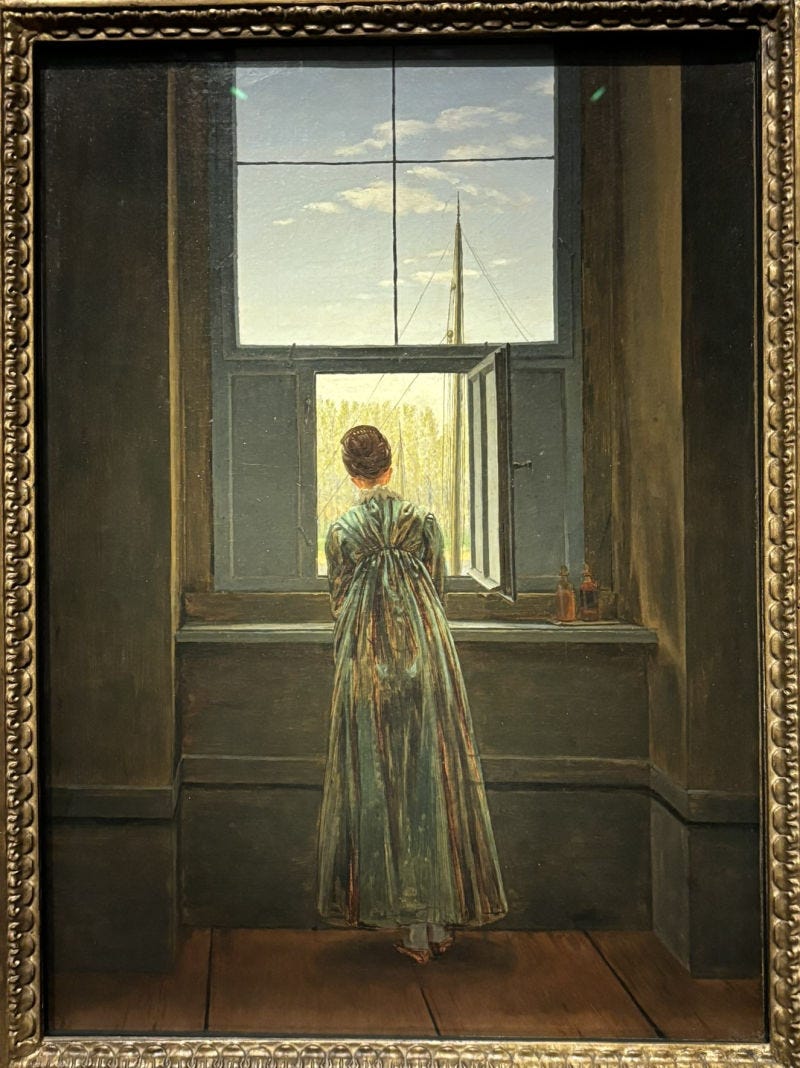
The creature’s tragedy is not that he is ugly or rejected or alone. His tragedy is that he cannot stop watching. He is constituted by the window. He learns what tenderness is by observing it, what family is by watching it, what longing is by feeling it from outside. He is the most feeling being in the novel because he has never been allowed inside. Exclusion has made his interiority immense.
He is also, Shelley insists, more capable of genuine relation than any of the humans in the novel. The De Lacey family, inside the warmth, does not watch each other with the creature’s attention. They do not need to. Inclusion produces the same incuriosity that assimilation produces — the comfortable inattention of people who have never had to build the commons from outside it.
The feed is the window. The product is the light behind it. The people watching are the creature — except they have been inside so long they have forgotten there was ever an outside4. The window is the world. The glass is the air. The watching is the feeling, and the feeling is sufficient, and there is nothing to remember.
The creature read Paradise Lost in the dark. He watched the family through the window. He understood everything he saw with a completeness that broke him. And then — this is the part Shelley insists on — he reached for language. He wrote it down. He told his story to the one person he believed might receive it.
That act is the protocol. Not the outcome. The act. The force directed outward, toward another mind, at the cost of exposure. Not the elimination of the force — its redirection.
10. The Protocol
The protocol survives. Not optimistically. Structurally.
Ostrom found that expelled communities do not destroy the commons. They rebuild it. They design. What they build carries the institutional memory of everything learned from being expelled — which is also everything the enclosing power cannot understand, because the enclosing power has never had to build under those conditions5.
The protocol is what the Black church networks carried through Jim Crow. What mutual aid societies built during redlining. What oral traditions maintained through slavery — forms of knowing not legible to the systems trying to dissolve them.
But here is what the Elias framework adds that the commons framework alone cannot: the protocol is not the elimination of aggression. It is aggression in the right direction.
The strenuous physical exertion that the school prohibition displaced did not need to be eliminated. It needed to be redirected. The force that would have been discharged in a schoolyard fight — the direct, legible, over-in-minutes resolution of a conflict between two people who both understand what is happening — needs somewhere to go. When it has nowhere to go, it goes inward. It goes covert. It learns to use the institution’s own vocabulary as a weapon. It becomes the coalition, the coordinated operation, the apology letter that demonstrates the absence of remorse.
The anti-bullying policy failed my daughter because it was organized around individual protection — documenting harm already done, producing letters. It had no mechanism for naming coalition behavior, no instrument for coordinated performance, no framework for collective harm that leaves no individual fingerprint. This is the same failure as the intent standard in Callais. The instrument was calibrated for a different form of the harm. The harm evolved. The instrument remained.
What my daughter needed — what the political commons needs — is not better documentation of harm. It is a different founding condition. An institution organized not around self-protection but around collective obligation. Not report what was done to you but help someone every day. The force redirected outward rather than inward.
I ask my daughter each afternoon whether she helped anyone. It is not a gentle question. It is a daily demand that the force in her be spent in a direction the coalition cannot weaponize.
It is barbarism in the right direction. It is the protocol.
11. Follow the Children
There are many places to act. The Brennan Center maps the redistricting litigation. The Prison Policy Initiative tracks the census gerrymandering. Campaign Legal Center is fighting the Equal Representation Act in the courts. The voting rights organizations are rebuilding what Shelby County dismantled, precinct by precinct. These efforts are necessary, and they deserve sustained attention and material support. Do not look away from the courtrooms. Do not look away from the census cycle. Do not look away from the map.
But the place we cannot afford to remove our eyes, hearts and minds from — the place the coalition is most dependent on us not seeing — is the public school.
School is where the mechanism is currently being seeded. When civics disappears from curriculum, when school counselors are cut to one for every five hundred students, when social-emotional learning is legislated against, when critical media literacy is replaced by standardized testing, when the library is purged of the books that teach children what exclusion looks like and what it costs — you are not merely underfunding an institution. You are producing the next generation of people who cannot read the mechanism. You are producing adults who will stand in the institution’s hall, holding apology letters, unable to distinguish between the person who needed space and the person who took it.
The coalition does not need to recruit the next generation. It needs only to produce it. And it is producing it now, in the buildings where we send our children every morning, through the budgets we vote on and the school boards we ignore, and the curriculum fights we dismiss as culture-war noise rather than the strategic defunding of democratic perception that they actually are.
A child who has never been taught the difference between a performed apology and a genuine one, between coalition behavior and a conflict between individuals, between institutional cover and institutional purpose — that child becomes an adult who cannot see Callais for what it is. The ruling works at scale because the population it most affects has been educated not to recognize it. The census strategy works because no one in the building taught anyone how to read a census. Gerrymandering works because civic geography is no longer part of what a school is expected to produce.
The dominant model — assimilate or be damned — has no mechanism for the question what does the room need? Asking that question requires acknowledging the room includes the people outside the fence. The civilized violence of the coalition is organized entirely to prevent that acknowledgment. And the most reliable way to prevent it across generations is to ensure that the institutions charged with developing that capacity in children have been stripped of the curriculum, the counselors, the library, and the time to do so.
This is why school board elections matter more than most national political observers will tell you. This is why the fights over what gets taught in fourth grade are not distractions from the “real” political battles. They are the real political battle, moved upstream, where the outcomes are slower to arrive but longer to last and harder to reverse — exactly the structure of every enclosure this essay has described.
The Griffith Observatory has been free since 1935. A man looked through a telescope and said: if all mankind could look through that telescope, it would change the world. So he built one. Gave it to the city. Put Ptolemy and Copernicus on the lawn side by side. Made the displacement of the observer a public institution, open late, free of charge, on a hill above ten million people.
That is not civility. That is barbarism in the right direction — the force spent building something the coalition cannot close, for people the coalition would prefer not to see.
The public school, funded and protected and genuinely invested with the capacity to teach children to read the room — to recognize coalition behavior, to distinguish performance from practice, to ask every day who in this room needs help, and to mean it as obligation rather than charity — is that institution. And it is under coordinated, deliberate, patient assault by people who understand exactly what it would produce if it were allowed to function.
Follow the children. Not as a metaphor. As a strategy. As the place where the protocol is either transmitted or extinguished, where the founding conditions for the next democratic emergence are either being built or being foreclosed, at a pace the news cycle cannot monetize and an urgency the outrage economy cannot reach.
The deed is signed. The jar is closed. The worm is circling. The aggression has been so thoroughly laundered through institutional vocabulary that the man who enacted the final enclosure did so in perfect good faith, having received the wages of forgetting before he was old enough to know the price.
And still: the creature at the window, reading in the dark, refusing to stop.
And still: a fourth grader asking each afternoon whether she helped anyone.
The wages of forgetting are very good. Collect them, and you lose the only thing that survives the enclosure — the capacity to feel, from inside your own body, that someone else’s exclusion is real. That the dictionary had their people in it too, once. That the window was everywhere, and the creature was pressing his face against it, and the light inside was very warm, and the family did not look up.
Protect the schools. Ask every day whether you helped anyone who needed it. Not as civility. As the protocol. As the redirection of the force the dominant organism, circling in its own consumption, cannot reproduce.
The jar is still sealed. The telescope is still on the roof.
It is still free.
Sources and Notes
A note on method
This essay braids personal observation, historical record, legal analysis, and political theory into a single argument. Where claims rest on the author’s own experience — the school incident, the daily question asked of a daughter — no external citation is provided. These are the experiential substrate from which the structural argument was developed. Everything else is sourced below.
Elias, Freud, and the Civilizing Process
Elias, Norbert. The Civilizing Process: Sociogenetic and Psychogenetic Investigations. First published in German, 1939. English translation, Blackwell, 1969 (Vol. I) and 1982 (Vol. II); single-volume edition, Blackwell, 2000. The argument that the civilizing process does not eliminate aggression but sublimates it is developed throughout, with particular attention to the relationship between state monopolies on physical force and the internalization of behavioral constraint. Elias’s observation that greater internal controls on violence within societies were historically accompanied by increasingly destructive power between rival groups is in the chapter “On Changes in Aggressiveness” (pp. 161–172 in the 2000 Blackwell edition).
Freud, Sigmund. Civilization and Its Discontents. First published in German as Das Unbehagen in der Kultur, 1930. Standard Edition translation, Hogarth Press.
The Dillingham Commission and Immigration Policy
Dictionary of Races and Peoples (Dillingham Commission, Vol. V, 1911), HathiTrust Digital Library. Immigration Act of 1924: standard legislative record. On the New Orleans lynching of 1891: Richard Gambino, Vendetta (Doubleday, 1977). On assimilation through the GI Bill: Ira Katznelson, When Affirmative Action Was White (Norton, 2005); Lizabeth Cohen, A Consumers’ Republic (Knopf, 2003). On Irish assimilation: Noel Ignatiev, How the Irish Became White (Routledge, 1995). On the triracial stratification hypothesis: Eduardo Bonilla-Silva, Racism Without Racists (Rowman & Littlefield, 2003–2022).
Prison Gerrymandering and the Census
Prison Policy Initiative, Prison Gerrymandering Project, prisonpolicy.org. On apportionment and non-citizen counts: Pew Research Center; Campaign Legal Center, campaignlegal.org. On the Equal Representation Act: Edwards House, edwards.house.gov.
The Republican Inversion and the Southern Strategy
On the Black voter shift: Nancy Weiss, Farewell to the Party of Lincoln (Princeton, 1983). Eisenhower’s 1956 Black vote share: Angus Campbell et al., The American Voter (Wiley, 1960). Johnson’s reported statement: Bill Moyers, Moyers on America (New Press, 2004); exact wording disputed. Atwater’s 1981 interview: Alexander Lamis, Southern Politics in the 1990s (LSU Press, 1999); unedited recording released by The Nation, November 13, 2012. 2024 election results: Edison Research exit polling (November 2024); Pew Research Center, How Different Groups Voted in the 2024 Presidential Election (November 2024).
The VRA and Callais v. Louisiana
On the VRA’s legislative intent to reach effects: J. Morgan Kousser, Colorblind Injustice (University of North Carolina Press, 1999). Case citations: Shelby County v. Holder, 570 U.S. 529 (2013); Brnovich v. DNC, 594 U.S. 647 (2021); Louisiana v. Callais (April 29, 2026). Kagan dissent quoted from slip opinion.
Alito’s Background
Alito Sr.’s origins in Saline Joniche, Calabria, and Rose Fradusco’s roots in Basilicata: Jeffrey Toobin, The Nine (Doubleday, 2007); Jan Crawford Greenburg, Supreme Conflict (Penguin, 2007).
Reconstruction and the Enclosed Commons
Eric Foner, Reconstruction: America’s Unfinished Revolution, 1863–1877 (Harper & Row, 1988). Compromise of 1877: C. Vann Woodward, Reunion and Reaction (Little, Brown, 1951). Ostrom, Governing the Commons (Cambridge, 1990). Hardin: Science 162:1243–1248 (1968).
Frankenstein and the Creature at the Window
Shelley, Mary. Frankenstein; or, The Modern Prometheus. First edition, 1818. The De Lacey family observation, the reading of Paradise Lost, and the creature’s written account are in Volumes II and III of the 1818 text.
Public Education and Democratic Capacity
On school counselor ratios: American School Counselor Association, national data 2024–2025. On civics education decline: Center for American Progress; iCivics national survey data. On social-emotional learning legislation: Education Week legislative tracker, 2023–2026. On library challenges and book bans: American Library Association, State of America’s Libraries reports, 2022–2026.
Prior Work in the Enclosurenomics Series
Su, Lin. “The New Idolatry.” March 2026. “Gray Sheep.” March 2026. “Worm in a Jar.” March 2026. “Enclosurenomics.” April 2026. “Legibility Theft.” April 2026. “The Enclosure of Mind.” May 2026. “Perverse Incentives.” May 2026. All published at Free Paradox, freeparadox.substack.com.
The operational architecture beneath the enforcement surface — the tech deployment methodology, the systematic creation of vulnerability, and the conditions it generates for exploitation — is examined in detail in “The Rehearsal,” Free Paradox, January 2026.
The mechanism of legibility theft — the systematic redirection of a victim’s own language back at them as the perpetrator’s defense, until the institution cannot distinguish between the two — is developed in full in “Legibility Theft,” Free Paradox, April 2026.
The sealed jar experiment and the tubifex worm as a model for closed system logic — dominance consuming the conditions of its own continuation — is developed in "Worm in a Jar," Free Paradox, March 2026.
The interior condition of that forgetting — what it looks like when a man mistakes his instruments for his life, and what it destroys — is examined in “The New Idolatry,” Free Paradox, May 2026.
The structural mechanics of enclosure — how commons get seized, what conditions make expulsion possible, and what the enclosed build in response — is developed in “Enclosurenomics,” Free Paradox, April 2026.
I don't mean to wear out my welcome.
Froma Zeitlin in "Playing the Other: Theater, Theatricality, and the Feminine in Greek Drama," Representations 11 (1985) p. 81:
"In the end, tragedy arrives at closures that generally reassert male, often paternal, structures of authority, but before that the work of the drama is to open up the masculine view of the universe. It typically does so, as we have seen, through energizing the theatrical resources of the female and concomitantly enervating the male as the price of initiating actor and spectator into new and unsettling modes of feeling, seeing, and knowing."
In short, Greek tragedy was ultimately a male project for men. That is, for the perpetuation of patriarchy. Notwithstanding its prominence in Greek drama, the feminine was always and forever means only. Never ends. Euripides' *Medea* was not an invitation to smash the patriarchy; it was yet another stress test for it.
This is where I struggle. The founding conditions of a system tend to ensure that the system's products do not touch its essence. Correct? Feminism and the Civil Rights Movement could be humored as long as they were thought to shore up the foundations of a marginally more enlightened white male supremacy. But honest-to-God redistribution of power and wealth? We are a half century into the backlash.
And at this stage of the backlash, one line is that it's sadly necessary because women and people of color (together with race traitors and uxorious men) have been guilty of overreach. Those tedious DEI workshops! Those silly acknowledgments of land expropriations from indigenous peoples!
Could better parenting at scale change the calculus? Yes! But I read your series of essays to be saying that a person who has only ever encountered three dimensions is highly unlikely to intuit the existence of a four- or eleven-dimensional universe. We can't see the boundaries because we've never seen anything but boundary.