
And Then What
Denim, Disenchantment, and the Case for Getting Hurt

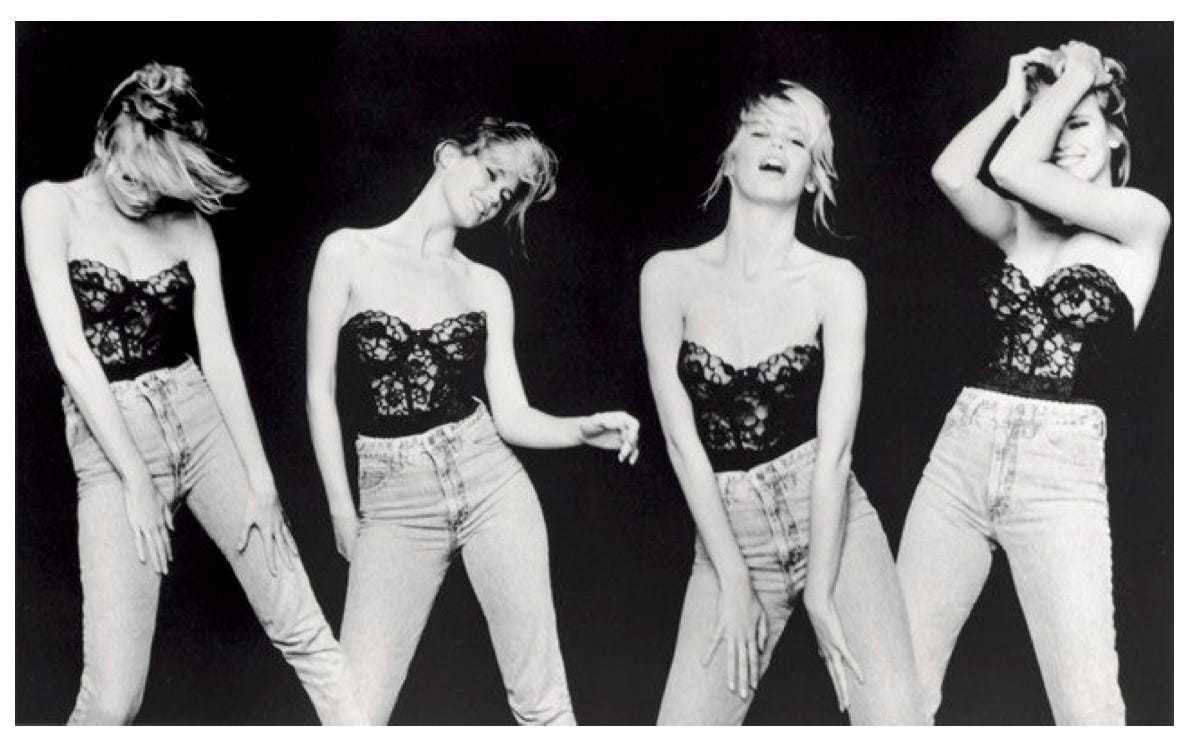
We tell ourselves stories in order to live, but by the mid-1980s, the story most people my age wanted to live in was an advertisement for Guess jeans.
It was a very specific kind of California narrative; all high-contrast black-and-white photography, rough stonewashed denim, and a relentless, calculated perfection that felt entirely alien to the life I actually occupied. I was a freshman in high school. I knew nothing about fashion, nor did I really care. My geography was defined by different coordinates: the soccer field, the local Optimist Club where I volunteered, and the quiet, sterile rooms of an intermediate care facility that sat somewhere between hospice and re-admittance to the emergency room. I spent my weekends holding the thin hands of the elderly, reading to people who were actively dying. It occurred to me then, in the way these things do when you are young and impressionable, that we all were dying. It was simply a matter of who was closer to the exit.
The rest of my time was spent at my parents’ furniture store. While the other kids roamed the local mall in tight, well-funded cliques, spending allowances they hadn’t earned, I was working the floor. I had a seat at a few different tables: the Goths, the skaters, the jocks, the thesbians, the band nerds, and the card-carrying role-players; they were a kind of extended family. That should have been enough. But the classist preppy kids, the ones we called the “perfects,” had a way of marketing themselves that made everyone else feel invisible. They wore the signifiers of the mid-80s peak middle class: Ralph Lauren, J.Crew, Lacoste, Gap, Izod, L.L. Bean. To possess those labels was to possess a passport to a country where nothing ever went wrong.
One afternoon, after a shift at the store, some friends who had been shopping together stopped by to see me. When they left, the contrast between their afternoon and mine felt too sharp to ignore. I sighed, letting a heavy, localized dissatisfaction settle over me, and I threw my mother some shade. She asked me what was wrong. I told her that everyone else had an aesthetic, that I was just, well, kinda invisible. I suggested that if I just had a single statement piece, the feeling might go away.
My mother was a woman who understood the high stakes of appearance. She was always neatly dressed in a Liz Claiborne-inspired uniform and made up to look professional and proper in any setting. She understood the immigrant dress code—the unspoken rule that to be socially acceptable in a Western society, you must never look sloppy, never look like you are failing. She enforced this code on us, though her translation could be eccentric; she had forced me into ill-fitting patent-leather saddle shoes that were always too small and decades out of style for my generation. I was still wearing saddle shoes with frilly ankle socks in Junior High, for Christ’s sake.
We had a long talk that day. She never said any of the Hallmark clichés that I wanted to hear — the earnest, protective phrases mothers use when their children begin to notice the world’s inequalities. She didn’t know clichés. She responded with Chinese idioms that were mostly lost on me at the time. I think she recited Learning to Walk in Handan, about a young man who traveled all the way to the city of Handan just to learn the locals’ incredibly graceful way of walking. He tried to copy every different person he saw, but in the process, he forgot his own natural stride. Ultimately, he failed to learn the new walk and had to crawl all the way back home. Simply said, don’t blindly imitate others. I just wanted the jeans.
Finally, she caved. We walked over to the brand store in the mall to try on a pair. The first pair fit like a glove, or perhaps like paint. I laid on the guilt and reminded her that up to that point, I had been wearing hand-me-downs from cousins that I outgrew in height. She bought them. $58.49, full price—an immense amount of money for denim in those years. That night, I took them out of the bag and simply stared at them. They were light-blue-stonewashed. I tried them on again before bed. The next morning, I picked a shirt to match, and when I walked into school, I felt different. Taller. More sophisticated. I felt visible.
The perfects noticed. As I walked down the hall, one of the girls whispered to another. I looked at them and waved. They waved back, that facetious, practiced wave of the popular girl, and giggled. I didn’t think much of it. It felt like a good day.
By third period, AP social science, my favorite class, the illusion broke. Outside the door, a friend’s backpack exploded, sending papers, a protractor, a ruler, and mechanical pencils scattering across the linoleum. I knelt down to help her gather her things, we went inside, and we took our seats. Towards the end of the lesson, the teacher asked me to distribute the homework assignment. I got up, handed the papers out, and the room dissolved into laughter.
I stood there, entirely uncomprehending, until the friend I had helped walked up. “I’ll help with those,” she said, taking the remaining papers from my hand. Then she whispered it: I had sat on ink.
My face went hot. In an instant, the memory of entering the room replayed itself with a cold, clinical clarity: the two perfects who had waved so sweetly earlier had broken a pen and dumped the blue ink directly into my seat. I knew it, but couldn’t prove it.
I asked to use the restroom. Standing in front of the mirror, trying to compose myself, what concerned me most was not the cruelty of the classroom, but my mother’s reaction. What am I going to do? I had no choice but to get through the day, sitting through the remaining periods with ink on the seat of my pants, needing only to make it home before my evening shift at the store.
When I got home, I tried every solvent available to remove the classic blue ink of a Pilot Precise pen from that $58.49 stonewashed fabric. Nothing worked. The stain was permanent.
So I made a choice. I had a pack of blue Pilots at home and started drawing on the pants. I broke the pens on purpose, letting the dark blue ink dribble and run across the denim, customizing every inch of it. Then I took a pair of needlework scissors and snipped the strings holding the iconic triangle Georges Marciano label in place. I figured that with a brand name like Guess, why would anyone need to see a label? When the patch came off, it revealed a perfect shadow—the dark, unstonewashed denim blue of the original fabric, matching the exact shade of the Pilot ink I had just graffiti’d across the legs.
They were better than they had been when they came off the line. They were mine, and they had a story.
I wore them to school the next day out of pure, cold defiance. The perfects never bothered me again. And within a few weeks, a strange thing happened: I started seeing other kids showing up in defaced Guess jeans, their labels snipped away, their denim customized. It was more of an anti-establishment statement than I had ever intended, but it was a fashion statement nonetheless. It was an aesthetic bought not with an allowance, but with a bit of grief, ink from a pack of pens, and the distinct realization that perfection is an illusion sold to people who haven’t yet learned how to survive their own days.
※
A few decades later, I think about what was actually on the advertisements in Jakarta, Kuala Lumpur, and Suva, in the parts of those cities where tourists go. My memory of this is partial, only what I happened to notice, but what struck me was how much of it was health and safety messaging: anti-smoking campaigns, transit safety, public health notices, often run in five languages on the same sign, which is not a thing you see on a billboard off the 405. In Tokyo and Taipei, it skewed toward something gentler still: places to eat, places to gather, ways to be together in public. I’m not claiming either region is some advertising utopia; I’m sure plenty of it was just convenience-store ads I’ve since forgotten, but the contrast with what I grew up with in America was real. The default subject of public space, in what I saw, wasn’t want this. It was don’t die or come sit down.
That contrast is dissolving anyway, regardless of what any single country’s billboards say, because the phone in everyone’s pocket has made the whole distinction moot. I can’t open a news feed anymore without running into something that reads like a friend baiting me to click on something; Every Trend That’s Going Viral This Summer First Originated in the ‘90’s, scroll several lines down, Orig: $275, $200 at Amazon — and increasingly, something I’d mentioned out loud near my phone twenty minutes earlier shows up as a stranger’s helpful opinion in a text message. The old geography of advertising doesn’t matter much when the ad has stopped living on a billboard and started living inside what feels like your own social circle.
Somewhere, right now, a school board or a parliament is voting to take the phones away; it’s already happening in a few places, framed as the obvious, overdue thing. I understand the instinct, and I think it’s the right instinct pointed at the wrong scale.
The problem isn’t that the machine exists. It’s that whoever’s doing the fixing isn’t thinking past the headline of having fixed it. You don’t get a kid back her own attention by confiscating the thing that’s been holding it for her; you get her back her attention by replacing what the device was actually providing — stimulation, status, somewhere to put her boredom — with something that isn’t a screen. What’s being described every time someone says “addictive design” is addiction, and nobody hands a person a chip1 and walks away. You build the meetings. You build the sponsor. You build the version of Tuesday night that isn’t just a kid alone with a phone.
Advertising was never really selling jeans or shoes or lipstick. It was selling a belief about yourself — that you were behind, that you were almost enough, that one more purchase would close the gap — and then it ran that belief through the population over and over until enough people held it that it looked like consensus. Somewhere along the way, it stopped even pretending to inform and became pure competition: not here is a thing you need, but notice me instead of them. That’s the same thing the two girls who broke a pen into my seat were doing. They were bored, and they wanted attention, and the fastest available route to it ran through me. Kids have always done this. The difference now is that the entire commercial architecture of the internet runs on the same instinct, scaled up and aimed by machines that never get bored or distracted, which means an entire generation is growing up inside a permanent, optimized version of that hallway.
I think about what might have reached those girls before the ink — not a lecture, but somewhere closer than a screen to put the same restlessness that made them reach for a pen. And I think about what actually happened instead: the ink forced me into the bathroom, into the decision, into the scissors and more broken pens, into solving it without an intermediary. Within a few weeks, half the school was wearing defaced Guess jeans. My one act of specific defiance became a trend, which means it became the same thing I was defying — a brand, with me as the label nobody saw. That’s the paradox underneath all of it. Every gesture toward authenticity gets copied, and every copy reinforces the belief that authenticity is something you can buy by copying it, until the whole system overfits on itself and the original feeling gets flattened back into dust, replaced by the next thing to perform.
The win was always going to be the headline — the ban2, the campaign, the policy3, the photo of the kid in the unbranded jeans — and never the outcome, which is a person who knows the difference between what she wants and what she’s been engineered to want. You can’t legislate that knowing into someone, and you can’t advertise it into them either. You arrive at it, if you arrive at it at all, by accident — alone, holding a pair of ruined pants, asking yourself: and then what.
Alcoholics Anonymous (AA) chips (or sobriety coins) are physical tokens given to members to celebrate milestones of continuous sobriety. While optional and not officially endorsed by AA's General Service Office, they are a beloved tradition, helping members honor their recovery journey from 24 hours to multiple years.
Hi. I loved your story and one that I can relate to. As a sixteen year old in California, I too wanted the jeans and the "look". Instead I spent all my after-school and vacations working in a CIA office under-cover with a Top Secret clearance. It was located at Moffitt Field in Mountain View. My youth was gobbled up with administrative tasks like typing and filing. This was my father's office,. My few friends thought I had committed a major crime, because the FBI came to their homes to ask about me and my bahavior. This was standard for the background investigation to get a Top Secret Clearance - but was not "standard procedures" for families of 16 year old high school friends. Little did I know at that point in time, that I would spend a lifetime doing Top Secret work, become a spy, lived in Russia for twenty years, and raised my own children in a communist country.
The ink trap set for you? I was thinking palm strike. Your response was better
Much better.
Tim Long, Just Up the Hill from Lock 15